



According to research, participating in regular physical activity which includes walking, cycling, cleaning, gardening, and taking part in sports could reduce Parkinson’s disease risk. The study revealed that individuals exercising the most had a 25% reduced risk of Parkinson’s when in comparison to individuals exercising the least.1✅ JOURNAL REFERENCE
DOI: 10.1212/WNL.0000000000207424
Exercise is a low-cost method for improving overall health, so the researchers wanted to establish if it could be associated with a reduced risk of Parkinson’s, a debilitating disease with no cure. The results present evidence for planning treatments to help prevent Parkinson’s disease.
The study involved 95,354 female individuals aged 49 years on average who didn’t have Parkinson’s at the beginning of the study. They were followed for 30 years during which 1,074 of them developed Parkinson’s disease.
Individuals completed up to 6 questionnaires throughout the study about the amounts and kinds of physical activity engaged in. They reported the amount of flights of stairs climbed and the distance walked every day, how many hours were allocated to household activities, and also the amount of time spent engaging in moderate recreational activities which included gardening as well as more vigorous activities which included sports.
Each activity was allocated a score according to the metabolic equivalent of a task, or METs, a method for quantifying energy expenditure. METs were multiplied by the duration and frequency for each activity to get a weekly METs-hour physical activity score.
For instance, a more intense kind of exercise such as cycling was 6 METs, and less intense kinds of exercise which included cleaning and walking were 3 METs. At the beginning of the study, the average level of physical activity for individuals was 45 METs-hours each week.
Individuals were divided into 4 even groups of approximately 24,000 individuals each. At the beginning of the study, the group with the highest activity levels had a weekly physical activity score of 71 METs-hours on average. The group with the lowest activity levels had a weekly score of 27 METs-hours on average.
There were 246 cases of Parkinson’s or 0.55 cases per 1,000 person-years in the group with the highest exercise levels in comparison to 286 cases or 0.73 per 1,000 person-years in the group with the lowest exercise levels. Person-years represent the amount of time each individual participates in the study as well as the number of study participants.
After adjusting for factors which included the place of residence, menopausal status and age of first period, and smoking, it was observed that the group with the highest exercise levels had a 25% reduced rate of Parkinson’s compared to the group with the lowest exercise levels when physical activity was evaluated up to 10 years prior to diagnosis; the association stayed the same when physical activity was evaluated up to 15 or 20 years prior to diagnosis. Similar results were seen after adjusting for diet or conditions which included cardiovascular disease, diabetes, and hypertension.
It was also observed that the of rate physical activity declined faster in individuals with Parkinson’s 10 years prior to diagnosis compared to individuals without Parkinson’s, probably as a result of early Parkinson’s symptoms.
This study not only found that female individuals exercising the most have a reduced rate of Parkinson’s, but it was also established that early Parkinson’s symptoms were unlikely to explain these results, and rather that exercise is beneficial and could help prevent or delay this condition. The results support the development of exercise programs to help reduce Parkinson’s risk.
A study limitation was that they were mostly health-conscious participants, so results may not be the same for the general population. The study doesn’t prove that exercise reduces the risk of Parkinson’s, It only shows a connection.
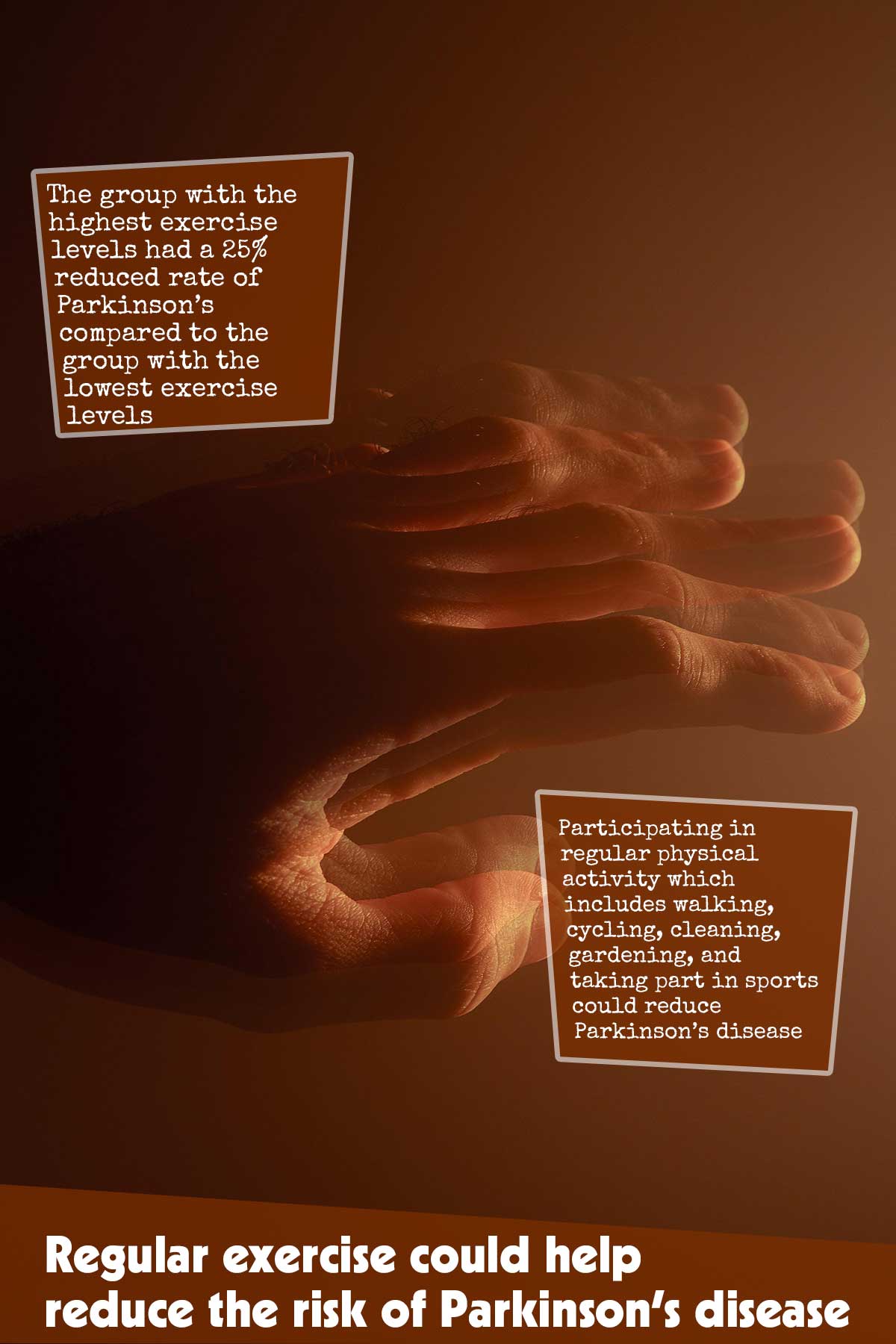
Image by Annick Vanblaere from Pixabay